
Choose Perplexity if your main job is finding information and following its sources; choose ChatGPT if your main job is drafting, revising, or working through a task in conversation. The practical Perplexity vs ChatGPT choice in 2026 is between a search-centered starting point and a general-purpose assistant—not between a truthful tool and an unreliable one.
- Perplexity vs ChatGPT: choose Perplexity for source-led research and ChatGPT for drafting and iterative problem-solving.
- Perplexity puts source discovery at the center; ChatGPT also supports web search and citations.
- Both offer free access and paid subscriptions. Compare current plan terms before subscribing.
- Neither tool’s citations replace reading the underlying source, especially for financial, medical, or legal decisions.
Why this matters
A polished answer and a supported answer are different things. An assistant can summarize a page accurately while missing an important exception. It can also attach a relevant citation that does not support the precise sentence beside it.
For general consumers, the useful question is what happens after the first answer. Do you need to open the original report, or turn your notes into something usable? That distinction guides this comparison, consistent with Joltjournal’s focus on explaining technology and money in plain English.
Perplexity is the better starting point for source-led research; ChatGPT is the better starting point for iterative writing. Neither recommendation establishes a universal accuracy winner.
At a glance
This 2026 comparison focuses on the services’ established roles. Individual features, model access, and usage limits depend on the account and plan you use.
| Dimension | Perplexity | ChatGPT |
|---|---|---|
| Best for | Finding information and tracing source material | Drafting, explaining, and developing work through conversation |
| Source discovery | Search-centered answers with source references | Web search with citations when search is used |
| Writing and revision | Useful for turning research into summaries | Better starting point for repeated drafting and revision |
| Follow-up questions | Useful for narrowing a research question | Useful for developing a task over several exchanges |
| Uploaded documents | Supports document-based questions, subject to plan limits | Supports document-based questions, subject to plan limits |
| Pricing model | Free access and paid subscriptions | Free access and paid subscriptions |
| Standout feature | A source-led starting point | A flexible conversational workspace |
| Main caution | Visible citations do not establish that every claim is supported | Fluent answers do not establish that facts were checked |
Perplexity is the better starting point for source discovery
Perplexity centers its service on answering questions through information retrieval and source references. That makes it a sensible first stop when you want to find the reporting, documentation, or research behind a topic.
Suppose you are comparing conflicting accounts of a technology announcement. Ask for the original company announcement, the relevant documentation, and independent reporting. Then open those sources rather than treating the generated summary as the final record.
ChatGPT also supports web search. OpenAI’s search documentation describes answers that include links to sources, so the distinction is not that one service cites and the other cannot. The difference is the starting workflow: search-led investigation versus a broader assistant that can also search.
Choose Perplexity for source discovery, not as a substitute for source checking. A list of references is useful because it gives you somewhere to investigate. Its presence alone says nothing about whether the answer has represented every source correctly.
For a 2026 purchasing decision, check the live service rather than relying on an old screenshot. Search controls, source presentation, and account entitlements can change.
ChatGPT is the better starting point for repeated revisions
ChatGPT fits work that develops through instructions and feedback. You can ask for an outline, reject its structure, supply additional material, and request a different version without turning each step into a separate research question.
That is useful for ordinary consumer tasks: rewriting a difficult email, explaining unfamiliar terminology, or turning your own notes into a clear checklist. The advantage is the conversational workflow, not a guarantee that its first draft is correct.
Perplexity can write and summarize too. Its source-led approach remains useful when the writing depends on external information. A research summary and a carefully revised letter, however, place different demands on the tool.
Choose ChatGPT when the deliverable is a draft you expect to revise. Give it the audience, purpose, source material, and constraints before asking for polished prose. Tell it not to add facts that are absent from your notes.
The trade-off is that fluent writing can hide weak evidence. If a draft includes a factual claim, ask where that claim came from. Editing a sentence into a more confident tone does not make its content more reliable.
Both handle follow-ups, but the question determines the value
Both services support follow-up questions. Neither requires you to get the prompt right on the first attempt, and neither deserves an automatic win simply because it can continue a conversation.
For research, a useful follow-up narrows the evidence: ask which source is primary, what date it covers, or whether it applies to the United States. For writing, a useful follow-up changes the output: ask for shorter sentences, a different structure, or a clearer explanation of a difficult term.
The practical test is whether the next answer improves the work. Repeating your preferred conclusion until an assistant agrees is not research. Asking for a more forceful version of an unsupported claim is not editing.
Use these prompts to keep the task on track:
- Research: Separate what the source states from your interpretation.
- Writing: Preserve the meaning and remove claims absent from my notes.
- Explanation: Identify the assumption that changes the answer.
- Comparison: State the strongest reason to choose the other option.
Call follow-up support a tie. Perplexity makes sense when the conversation stays focused on finding evidence; ChatGPT makes sense when the conversation develops a deliverable.
Both support document questions; neither replaces reading
Both services support working with uploaded material, with access and limits governed by their current plans. That makes either a candidate for explaining a document or locating passages relevant to your question.
The important distinction is between locating text and interpreting it. Finding a fee provision is different from deciding whether it applies to your account. Summarizing a contract is different from checking every exception and defined term.
Ask the assistant to identify the relevant section and reproduce the supporting passage. Then check that passage in the original document. For tables, inspect the headings, units, notes, and reporting period yourself.
Treat document analysis as a tie until your own document shows a meaningful difference. Use a nonsensitive sample when comparing the services. A tool that gives a shorter answer is not necessarily missing information; a longer answer is not necessarily more complete.
Before uploading personal material in 2026, read the applicable data controls and privacy terms. Remove account numbers and other identifying details when they are unnecessary to the task. Do not assume consumer accounts and organizational accounts have identical terms.
Pricing models are similar; useful access determines the value
Perplexity and ChatGPT both offer free access and paid subscriptions. Their official plan pages and help documentation are the right places to check current entitlements, billing terms, and usage limits before paying.
The basic trade-off is similar: free access lets you assess the workflow, while paid access can provide additional capabilities or greater usage allowances. A subscription does not mean unrestricted use of every feature.
For a 2026 comparison, inspect these items rather than choosing from a plan name:
- Included tools: Check whether the task you need is included in that tier.
- Usage limits: Look for separate restrictions on search, uploads, and other advanced functions.
- Billing period: Distinguish recurring monthly billing from a longer commitment.
- Renewal terms: Read cancellation and renewal conditions before subscribing.
- Account type: Check which privacy and administrative terms apply to your account.
Start with free access if it lets you evaluate the task you actually perform. Pay when a documented restriction blocks useful work, not because a plan’s model list sounds impressive.
There is no evidence here for declaring either subscription the better financial value for every reader. Your recurring task and the current terms determine that comparison. Joltjournal’s recommendation is to evaluate the work completed, not the length of the feature list.
Perplexity stands out for finding; ChatGPT stands out for making
The clearest distinction is what you want to leave with. Perplexity is a strong starting point when the output you need is a set of sources and an explanation of what they establish. ChatGPT is a strong starting point when the output you need is a draft, explanation, or structured piece of work.
That is a workflow recommendation, not a claim that either service is incapable of the other task. Both can search, explain, and write. Choosing a starting point reduces unnecessary switching.
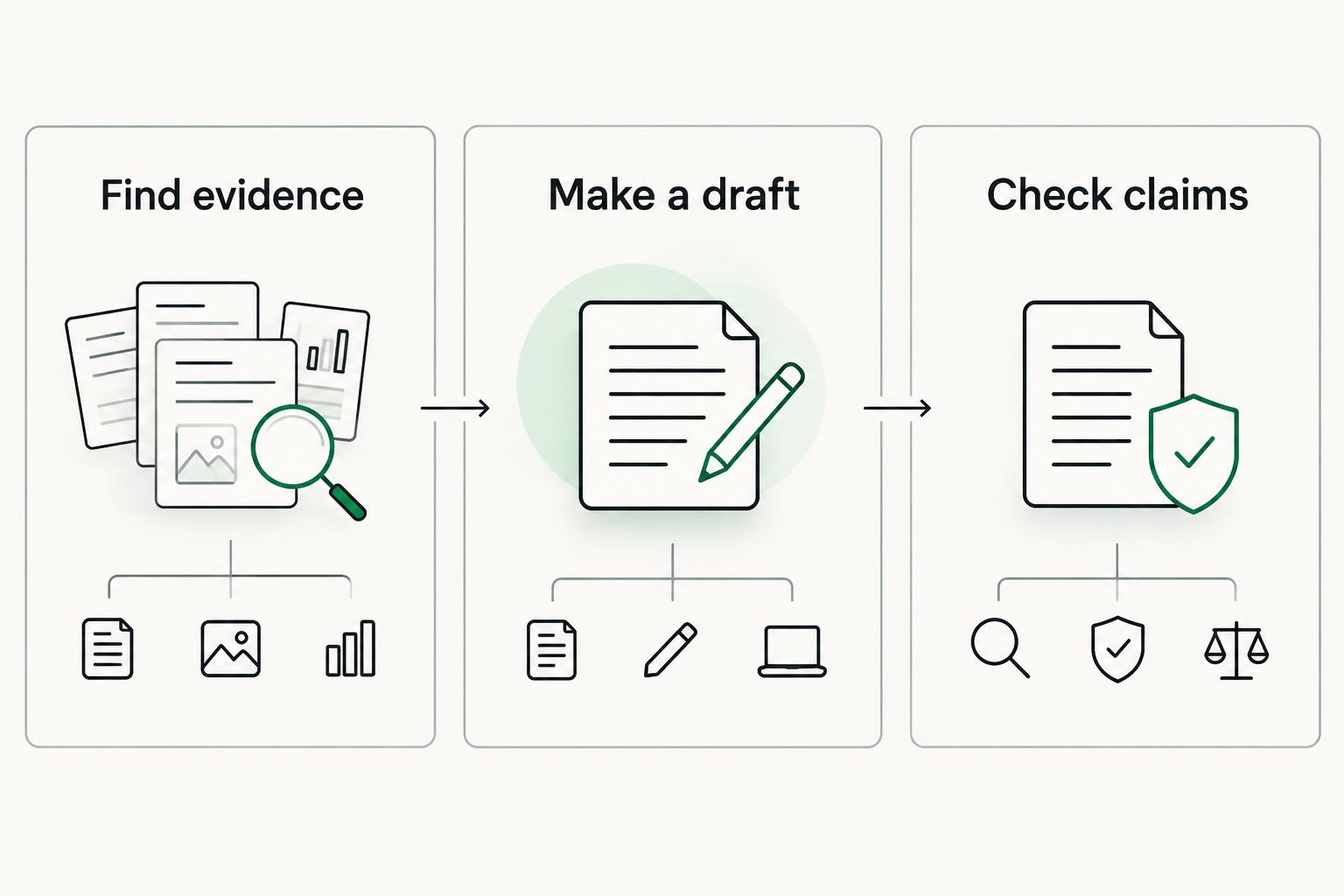
Use this simple distinction:
- Find evidence: Start with Perplexity and inspect the underlying material.
- Make a draft: Start with ChatGPT and provide the facts it must preserve.
- Check claims: Return to original sources before relying on either answer.
You do not need overlapping subscriptions simply because both services can help. First identify whether your recurring frustration is finding reliable material or turning material into a useful result.
Neither wins trust merely by sounding certain
Perplexity’s main caution is that visible references can invite premature trust. ChatGPT’s main caution is that a coherent explanation can do the same thing without making the evidence equally prominent.
OpenAI and Perplexity both warn in their public guidance that generated answers can contain errors. That warning matters more than a confident tone or an attractive source list.
For consequential claims, use a short verification sequence:
- Open the cited or named source.
- Find the passage supporting the exact claim.
- Check its date, scope, and exceptions.
- Separate the source’s statement from the assistant’s interpretation.
For personal finance, favor the relevant regulator, government agency, or provider’s current disclosures. A general explanation of a financial product does not establish your eligibility or determine whether it suits your circumstances.
Neither service earns a general accuracy crown from this comparison. Joltjournal’s position is narrower: use citations to inspect evidence and use conversational editing to improve presentation. Do not confuse either benefit with verification.
Final verdict: choose by the work you need finished
Choose Perplexity if you are a source-first reader
Perplexity wins for the reader whose next action is opening and evaluating sources. Start there for questions about reporting, unfamiliar subjects, or competing factual claims. Its limitation is that you still have to establish whether the references support the answer.
Choose ChatGPT if you are a draft-first user
ChatGPT wins for the user whose next action is revising a deliverable. Start there for explanations, outlines, emails, and structured work built from your instructions. Its limitation is that good prose can contain unsupported facts unless you control and check the source material.
For 2026, make the decision on that recurring task first. Compare paid terms only after the workflow proves useful.
| Dimension | Winner |
|---|---|
| Best fit for source-first readers | Perplexity |
| Source discovery | Perplexity |
| Writing and revision | ChatGPT |
| Follow-up questions | Tie; task determines fit |
| Uploaded documents | Tie; assess your document |
| Pricing model | Tie; compare current terms |
| Standout workflow | Perplexity for finding; ChatGPT for making |
| Trust without verification | Neither |
FAQ
Is Perplexity better than ChatGPT for research?
Perplexity is the better starting point for source-led research. ChatGPT also supports web search, so check the underlying evidence rather than assuming one service always produces the more accurate answer.
Is ChatGPT better than Perplexity for writing?
ChatGPT is the better starting point for repeated drafting and revision. Perplexity remains useful when your writing task begins with finding and summarizing external sources.
Does ChatGPT provide sources like Perplexity?
ChatGPT can provide source citations when using web search. Do not assume that every answer has searched the web or that a citation supports every nearby claim.
Can I use Perplexity and ChatGPT without a subscription?
Both services offer free access. Check their current official plan terms for the tools and usage allowances available to your account.
Which paid subscription should I choose in 2026?
Choose based on the recurring task that free access cannot adequately support. Compare current included tools, usage limits, billing periods, and cancellation terms before subscribing.
Can I upload financial documents to either service?
Both services support uploaded material, subject to account and plan limits. Review the applicable privacy terms and remove unnecessary personal information before uploading sensitive documents.
Can I trust the citations in a generated answer?
Treat citations as a route to evidence, not proof that the answer is correct. Open the source and check the exact claim, publication date, scope, and exceptions.
One last thing
A useful comparison question is not simply which answer sounds better. Ask each service: Which source would change this answer, and what would it need to say?
That question directs attention to the evidence instead of the wording. For Joltjournal readers, the strongest result is an answer you can inspect, correct, and use—not one you merely find convincing.